


We bridge the gap between technological research and society. From hands-on science in schools and major public festivals to preserving the history of electronics and developing sustainable, inclusive health tech: see how the Department transforms innovation into shared progress.
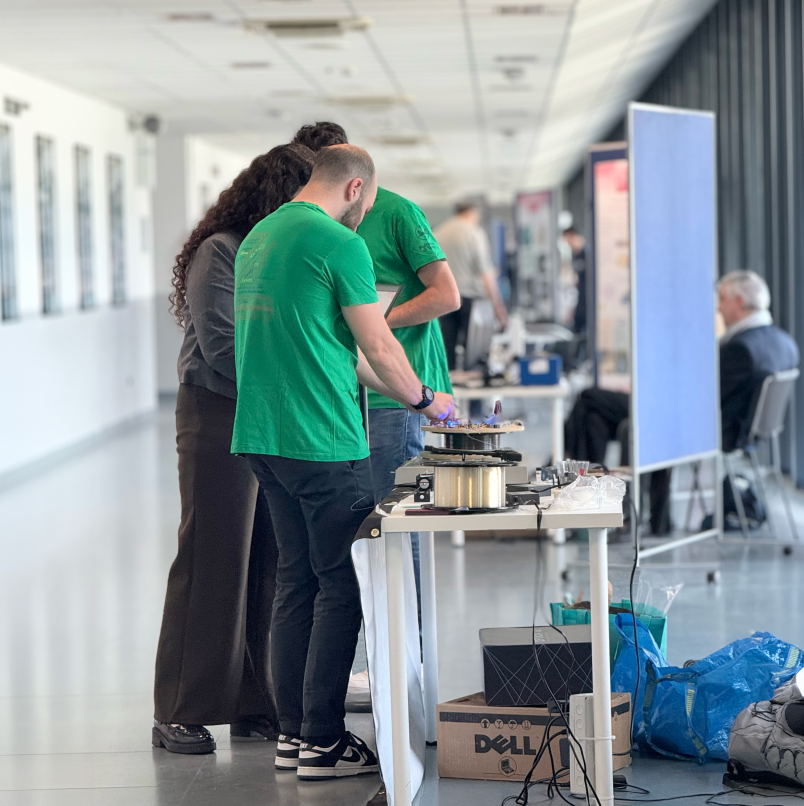
We are actively engaged in public engagement initiatives that foster dialogue between technological research and society. Through outreach events, seminars, and participation in science festivals, we promote awareness of the Department's research activities and their impact on society. In particular, we contribute to the Technology Biennial (Biennale Tecnologia) and the European Researchers' Night with interactive exhibits, demonstrations, and hands-on activities.
We are also committed to engaging with schools through outreach and orientation initiatives, making extensive use of our teaching and research laboratories to inspire young people to pursue STEM disciplines. These activities not only make complex scientific concepts accessible to a wider audience but also stimulate curiosity and raise awareness of today's technological challenges. In doing so, we strengthen our connection with the local community, promote scientific culture, and contribute to a positive societal impact.
Stay connected by following our social media channels
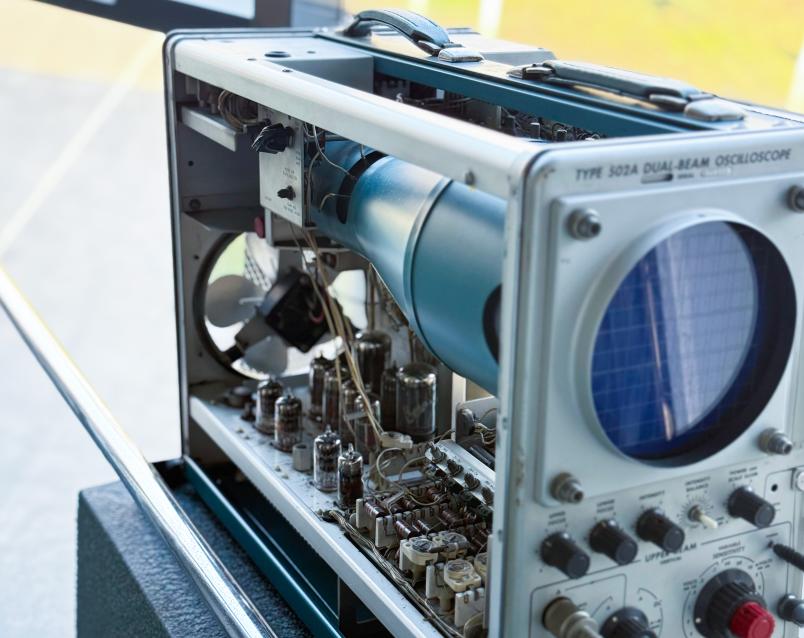
Our collection of oscilloscopes is on display in the hallway of the LED teaching laboratories (second floor, Cittadella Politecnica) and consists of a series of instruments built between 1949 and the early 2000s, chosen to tangibly and memorably represent an object that has become a true cultural symbol. Each instrument is accompanied by a brief technical data sheet summarizing its main features. The aesthetic and functional restoration of the displayed instruments was carried out by engineer Gianfranco Albis (DET).
With the evolution of electrical engineering into electronics, measuring current was no longer enough: it also became necessary to "visualize" its behavior over time. In 1897, the German physicist Karl Ferdinand Braun, winner of the Nobel Prize in Physics in 1909, developed a high-vacuum tube to study the behavior of electrons. Thus was born the cathode-ray tube, destined to become the heart of the oscilloscope. The first commercial model appeared in 1931 in the catalog of the American company General Radio. Since then, the oscilloscope has evolved alongside technology, becoming an indispensable tool for the development of electronics.

We have long been committed to promoting sustainable technologies and responsible innovation in electronics, while supporting initiatives that address the social and cultural dimensions of health and well-being.
We place particular emphasis on bioengineering, collaborating extensively with hospitals, research institutions, associations, and industry partners. Our activities range from healthcare systems and services to the development of innovative medical devices, as well as advanced techniques for the acquisition and analysis of biomedical signals and images, supporting both clinical practice and fundamental research.
Our expertise also contributes to promoting health and well-being by improving access to services and opportunities enabled by technological innovation. In this context, we develop inclusive solutions for culture and communication while encouraging the active participation of local communities. The Department also contributes to the initiatives of the PoliTO Centre for Social Impact and actively participates in the University's Green Team.
Our research addresses some of today's most pressing environmental, social, and healthcare challenges through innovative electronics and information technologies. Key research areas include renewable energy and energy conversion, ultra-low-power electronics and communication systems, environmental monitoring, and technologies for agriculture and the agri-food sector.